Sunday, September 22, 2013

Turtle Bay Treasures

Which New York neighborhood has the wealthiest property?  The high-rise coops on 5th avenue overlooking Central Park certainly come to mind.  But let's not forget the townhomes surrounding Gramercy Park, including the "finest house in New York" at 19 Gramercy Park South.  But after a stroll through Turtle Bay (the area of midtown Manhattan between 43rd and 53rd street and east of Lexington Ave) certainly has "swank."

Overlooking the Hudson River at 1 Sutton Place (near 57th st) is the home of Teresa Heinz, heiress to the Heinz fortune and wife of Secretary of State John Kerry.  The home was built for the wealthy Mrs. William Vanderbilt, who was induced to move from her 5th avenue brownstone to Sutton Place by developers of the new Sutton Place enclave.  The goal was for Vanderbilt to act as "window dressing" to get people to move further east to Sutton Place.  Next door, at 3 Sutton Place, is the home of the Secretary General of the UN.  According to a 1994 New York times, a 2 bedroom, 2 bath home at 20 Sutton Place was on the market for $335,000, quite a steal in today's market.


Down the street from the Heinz mansion, is the former home of John D. Rockefeller, at 1 Beekman Place (near 50th st overlooking the East River).  Beekman Street is one of the wealthiest and smallest in all of Manhattan.   Irving Berlin, the composer of "White Christmas" fame lived for 40 years at 17 Beekman place until he passed away at the age of 101.  It now houses the Luxemburg government in New York City.


A few feet away is 39 Beekman place, a 5,300 square foot, 5 story townhome that appears to be valued at $7.3 million.  Interestingly, Aristotle Onassis purchased the home in 1968 for his new bride Jackie Kennedy.  The paparazzi set up shop full time next door, and the new couple never moved in.  The image to the rest shows the back side of the mansion.  It has plenty of outdoor space to barbeque and take in the scenic East River views, overlooking Queens and Roosevelt Island.

Finally, just east of 58th and Sutton Place leads to Riverview Terrace, shown to the bottom right.  It is one of the most private cul-de-sacs in all of Manhattan, complete with a private guard gate and cobble stonesstreet not open to the public.  It even

has private garages for each of the six row homes.  Who knew Manhattan had a private street?  The homes are elegant beauties, each in their own way.  A 1921 New York Times article described the homes at Riverview Terrace as "settled in the 1870s by nice people who were erratic enough to prefer a view of the river to a more convenient location."  Looks like they had it right, and the location sure makes for a nice escape from the hustle and bustle of the city.  Turtle Bay has many lush properties to brag about, but the homes at Riverview Terrace may just be the best.


Sunday, September 15, 2013

The Ghosts of West Village

On a crisp fall day, I decided to check out some of West Village's charm and past.  It certainly did not disappoint, and by the end of my walk I was surprised how little I knew about the neighborhood and how much I had missed on my many trips through it.  First stop was Marie's Crisis Café at 59 Grove St (off 7th avenue).  It's currently a vibrant piano bar that usually stays open until the wee hours of the morning, but it has an interesting past. 


Thomas Paine, author of Common Sense (1776), died there in 1809.  After the American Revolution, Paine moved to France and became actively involved in the French Revolution.  He returned to New York City in 1802 and lived at 59 Grove Street until his death in 1809.  He became ostracized for his later works denouncing institutionalized religion, and only six people attended his funeral.

The plaque on the wall that the two people are looking at in the picture contains his epitaph: "The world is my country, to do good is my religion, and all mankind are my brethren."  The spot was turned into a brothel from 1850-1890, and later a speakeasy during prohibition.  The bar was renamed in honor of Paine's "Crisis" pamphlets during the American Revolutionary War.


Just down the street from Marie's Crisis Café is the narrowest house in New York.  At just 9.5 feet wide and 30 feet deep, 75 1/2 Bedford Street is a house on a diet.  Despite its small size, it was purchased in 2010 for the hefty price of $2 million dollars.  One year later, it was put on the market for $4.3 million.  The home's unique size is due to the fact the lot originally served as a carriage entrance to the adjacent homes' stables.  The house also served as the home of actor Cary Grant, who apparently didn't suffer claustrophobia.

A short walk west led to the White Horse Tavern, yet another gem in the neighborhood at 567 Hudson St.  The bar opened in 1880, but gained its fame during the 1950s and 60s when Bohemian authors frequented the watering hole.  According to legend n November 8, 1953, Welsh poet Dylan Thomas, whose works include "Do not got gentle into that good night," drank 18 whiskies there before dying the next morning at the nearby Chelsea Hotel.  Bob Dylan, Jim Morrison, and Hunter Thompson also frequented the Tavern.  The next time you are in West Village, take a look around.  The ghosts of West Village are everywhere! 


Wednesday, June 26, 2013

1939 World's Fair

It's not very common that I find eye-witness testimony about the material I write about.  Writing about events that took place decades or centuries a good offers an interesting glimpse into the past, but few are still around to tell about it.

This past weekend at my brother's wedding, I met an 88-year-old woman who told me she visited New York City once, 74 years ago.  The year was 1939 and she took a Greyhound bus from South Carolina to New York City to visit the 1939 World's Fair.  What was this event that was apparently compelling enough for her to endure a 3 day bus ride?

Souvenir Booklet of 1939 World's Fair

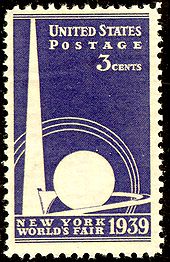
Stamp showing the "Perisphere"


People Entering the Perisphere
 The 1939 World's Fair took place on the current site of the Met's Stadium in Queens.  Over 44 million people attended the event.  At the center of the grounds was the "Perisphere" a dome-shaped construction which become symbolic of the 1939 World's Fair.  The 180 foot diameter dome featured "Democracity," a model city of the future, which was viewed from a moving escalator.

The 1200+ acre grounds for the event were divided into zones, including a Transportation zone, Communications and Business Zone, Food Zone, and Government Zone, with a focus on the future. 
The Transportation zone, for example, featured new automobiles from GM and Chrysler which could be viewed in a room cooled by air-conditioning, a novelty at the time.  The purpose of the event was to uplift the human spirit following the Great Depression of the 1930s and to strive to bring global harmonization to a world on the brink of warfare.
Grounds of the 1939 World's Fair

Sunday, June 9, 2013

Plane Crash Into the Empire State Building

Long before the tragedy of 9/11, New York was shook by another plane crash.  On the foggy morning of Saturday July 28, 1945, just two weeks before the United States dropped atomic bombs on Japan to end World War II, the pilot of a US B-25 bomber became disorientated on his was to a routine personnel drop at Newark airport and crashed into the Empire State Building. 

The death toll was only 14 but could have been much higher had it occurred on a weekday when more people were at work.  The crash occurred at 9:40 am and carved a 18 x 20 foot opening in the Empire State Building, engulfing the building in flames.


One of the plane's engines landed in the elevator car, sending the elevator operator Betty Lou Oliver plummeting 75 stories (1000 feet).  Miraculously, she survived the fall, and her fall is recorded in the Guiness Book of World Records as the longest survived elevator fall.

Sunday, March 10, 2013

Hugh O'Neill Store

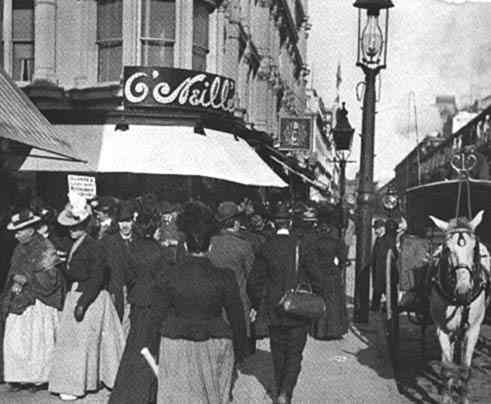
Not long ago I did a post called "Meet me at the Fountain" about Ladies Mile, a stretch of emporiums that ran down 6th avenue between 14th and 23rd street in the late nineteenth century.  The Hugh O'Neill Store between 20th and 21st on 6th avenue was one of the great dry goods stores of its day on Ladies Mile.  Opened in 1887, the Hugh O'Neill store had a staggering 2500 employees.  Unique among other emporiums, the façade of the four-story Hugh O'Neill store was originally painted yellow and black and had two large beehive columns.  The Hugh O'Neill store was accessible by the above-ground 6th avenue El train which ran all the way to Central park.

While other emporiums, like Macy's, moved north to 34th street in the early twentieth century, the Hugh O'Neill store stayed put and eventually went under in 1907.  Today, the Hugh O'Neill store is an upscale condominium building.

Tuesday, December 25, 2012

Anthrax Island

I spent one of my first summers as a New Yorker just outside the city in Montauk, one of the villages surrounding Long Island's Hamptons.  Just off the coast of Montauk is one of the country's more mysterious locations.  The Plum Island Animal Disease Center occupies a 3 by 1 mile island, which is replete with its own fire department, power plant, water treatment plant, and, of course security.  The island, once used to protect New York City in the Spanish-American war at the turn of the 19th century, became a biological-weapons and animal disease research laboratory after WWII.  It is currently owned by the Dept. of Homeland Security.

Plum Island- NW of Long Island
Personnel are ferried to and from the island by armed security officers, and the public are not welcome.  Before entering the island, the personnel must strip naked and put on plastic clothing.  No animal is allowed to leave the island alive and any animal on the island is killed if it comes on-shore. According to a 2002 Wall Street Journal article, freezers on the island contain live polio, Rift Valley Fever, and a host of other deadly diseases.  Plum Island's stated objective is to study diseases communicated between man and animals, but many suspect the laboratory's research goes much deeper.  In 2008, suspected Al Qaeda terrorist Aafia Siddiqui was captured in Afghanistan with a liter of Cyanide in her purse and a list of potential US targets.  Plum Island was included on that list.

"Montauk monster" washed ashore in 2008


The island has been the subject of many conspiracy theories.  Some believe Lyme disease originated on the island and was communicated by accident to nearby Lyme, Connecticut where it spread to the mainland.  Separately, many believe the island has been the source for genetically mutated animals, including what has been dubbed the "Montauk monster," a beastly looking creature that washed on Montauk's shore in July 2008 and horrified three beach-goers.  The mystery has never been solved, although some scientists contend the animal is merely a raccoon or a turtle.  In the 1989 film Silence of the Lambs, Hannibal Lecter is offered vacation time on "Plum Island Animal Disease Center" if he cooperates.  Pausing, he mocks the island by calling it, "Anthrax Island."


Sunday, December 23, 2012

Laying Grand Plans

There's something about the libraries around Gramercy Park that I like.  Looking through the big windows of the houses facing the park, you can almost feel the ghosts of their present owners- sipping coffee and reading the news in front of a glowing fire.  A second floor library on the north side of the park played host to a series of significant meetings in the mid 1850s.  The townhome, with its elegant library, belonged to Cyrus Field, a paper manufacturing tycoon who retired at 34 after acquiring a small fortune of $250,000.
Cyrus Field


Field had two prominent neighbors: Samuel Morse, telegraphy pioneer and inventor of Morse code, to the north and Peter Cooper, designer of the steam locomotive and once presidential candidate, to the east.  In the mid 1850s, Field, Cooper, Morse, and several other investors began meeting in Field's second floor library to discuss plans for the first Atlantic telegraph.

Field had become obsessed with the idea since financing the laying of telegraph wires in Newfoundland (northeast Canada in 1854).  The idea of laying communication wires under the sea was daunting-given 2500 miles separated Newfoundland and England-but the Field was devoted to the task.  In the 1850s, the only way to communicate a letter over the Atlantic was by sea, which took approximately 10 days.  Telegraph wires would allow for nearly instantaneous communication.  Under Field's vision, on August 7, 1857 two steamships left Newfoundland and Liverpool. 

Marker at what is left of Field's former home (21st and Lex)

After a catastrophic start that included numerous broken cables, storms, etc., the two ships met in the middle of the Atlantic in 1858 and the two wires were spliced together.  Queen Victoria of England sent the first trans-Atlantic communication to President Buchanan in 1858.  To read an 1858 New York Times Article on Field's heroic feat, click here.  Field's success was short-lived.  The communication broke in 1858, and Field, once a hero, was now viewed as a fraud.  According to the book Gramercy Park: An American Bloomsbury, grown men turned their backs when Field came near. 

After 7 years and many failed attempts, the telegraphy wires were finally fully operational and Field was vindicated in the plans he, Morse, Cooper, and other laid years before in his second floor library.  At a benefit in his honor at New York's Chamber of Commerce, Peter Cooper toasted his friend with the now famous line, "God rewards patient industry."